Bifacial Solar Panels vs. Traditional Panels: Which Performs Better In Nigeria?
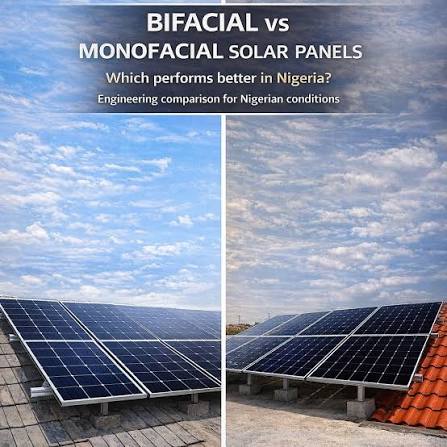
Bifacial panels can produce more energy, but they do not magically double the electricity you get from a panel. The amount of extra power you get depends heavily on what is underneath the panel, how high it is installed, how much sunlight reaches the back and how reflective the surrounding surface is.
If you have been shopping for solar panels in Nigeria in 2026, you have probably come across a new term: bifacial solar panels.
At first, the idea sounds straightforward. A normal solar panel collects sunlight from one side, while a bifacial panel can collect light from both the front and the back.
So, naturally, you may be wondering:
If one panel can collect sunlight from both sides, why would anybody still buy traditional panels?
The answer is a little more complicated.
Bifacial panels can produce more energy, but they do not magically double the electricity you get from a panel. The amount of extra power you get depends heavily on what is underneath the panel, how high it is installed, how much sunlight reaches the back and how reflective the surrounding surface is.
For a Nigerian homeowner, that distinction matters.
What Is a Bifacial Solar Panel?
A traditional solar panel is usually called a monofacial panel.
It has solar cells on the front, and most of the sunlight it uses comes directly from the sky.
A bifacial panel has solar cells that can receive light from both sides. The front captures direct sunlight, while the rear can capture sunlight reflected from the surface beneath the panel.
That reflected light is known as albedo.
Think about a panel sitting above a bright concrete roof. Sunlight hits the roof, bounces back upward and reaches the rear of the bifacial panel.
The panel gets an additional opportunity to generate electricity.
That is the basic idea.
And it is not just marketing. Research from the U.S. National Renewable Energy Laboratory has shown that bifacial modules can outperform comparable monofacial modules when conditions allow the rear side to receive useful reflected light.
But there is a catch.
The back of the panel needs light.
If you install a bifacial panel flat against a dark roof with very little clearance underneath, there may not be much additional light reaching the rear.
In that situation, you are paying for a feature you are barely using.
Bifacial vs. Traditional Solar Panels
Here is the simple comparison:
| Feature | Bifacial Panel | Traditional/Monofacial Panel |
|---|---|---|
| Generates from front | Yes | Yes |
| Generates from rear | Yes | No |
| Potential energy yield | Higher in suitable conditions | Standard |
| Works with normal solar inverters | Generally yes, if specifications match | Yes |
| Needs reflective surface to benefit | Preferably | No |
| Installation can be more demanding | Sometimes | Usually simpler |
| Usually costs more | Often | Usually cheaper |
| Best for | Open, elevated installations | Most conventional rooftops |
The important word here is suitable.
Bifacial is not automatically better simply because it has two active sides.
How Much More Electricity Can Bifacial Panels Produce?
This is where you need to be careful with the numbers you see online.
You will sometimes see claims that bifacial panels produce 20%, 30% or even 40% more electricity.
Don't assume your home will get that kind of increase.
The actual gain depends on factors such as:
- Roof or ground reflectivity
- Panel height
- Panel tilt
- Distance between panels
- Shading
- Sun position
- Rear-side irradiance
- Installation structure
NREL's research highlights that rear irradiance varies depending on ground cover, spacing, shading and the height of the panels above the ground.
In practical residential installations, a modest additional yield can be more realistic than the dramatic numbers sometimes used in advertisements. One 2026 Nigerian solar buying guide, for example, estimates roughly 5–15% additional rooftop yield for suitable bifacial installations.
So if a 550W bifacial panel is advertised as "550W + 30%," don't interpret that as a guaranteed 715W panel.
The 550W is still the panel's rated front-side capacity.
The rear-side contribution is additional energy that depends on the installation conditions.
Why the Roof Matters So Much
This is probably the most important thing for a homeowner to understand.
Imagine two houses.
House A
The homeowner installs bifacial panels almost directly above a dark roofing material with very little space underneath.
The roof absorbs a lot of sunlight.
There isn't much reflected light reaching the rear of the panels.
The bifacial advantage may be relatively small.
House B
The homeowner installs the panels several centimetres above a bright, reflective surface with good airflow and plenty of open space underneath.
Sunlight hits the surface, reflects upward and reaches the back of the panels.
Now the bifacial design has a better opportunity to earn its premium.
Same type of panel.
Completely different result.
This is why a solar installer should consider the entire installation, not just the panel's wattage.
What About Nigerian Roofs?
This is where things get particularly interesting.
Many Nigerian homes have concrete roofs, metal roofs or other surfaces that can behave differently when it comes to reflected sunlight.
A bright concrete surface can provide more useful reflected light than a very dark surface.
However, the colour and material are not the only factors.
Panel height, roof layout, shading and installation angle also matter.
If your installer simply puts the panels close to the roof, the rear side may not get enough light to make a major difference.
For bifacial panels, installation design matters more than it does for a simple monofacial setup.
Are Bifacial Panels More Expensive?
Usually, you should expect to pay a premium for bifacial panels, although the difference has become less straightforward as bifacial modules have become more common.
For example, a Nigerian 2026 listing puts a standard 500W monocrystalline panel around ₦185,000–₦240,000, while bifacial 500W variants start around ₦215,000 on that particular marketplace.
But prices vary significantly between brands and sellers.
Current September 2026 Nigerian listings also show some 600W bifacial Jinko panels around ₦110,000–₦120,000, while certain JA Solar bifacial models are listed around ₦139,000–₦150,000.
That is why you should not assume:
Bifacial = automatically much more expensive.
Compare the actual models and, more importantly, compare their price per watt.
What Is a Traditional Solar Panel?
When people say "traditional solar panel," they are usually referring to a monofacial panel.
It doesn't mean the panel is old or outdated.
Modern monofacial panels can still use advanced technologies such as N-Type TOPCon and other high-efficiency cell designs.
So don't make the mistake of thinking:
Bifacial = new and good
and
Monofacial = old and bad.
That's not how it works.
A good 550W monofacial panel from a reputable manufacturer can be an excellent choice for a Nigerian home.
The question is whether you can actually benefit from the extra rear-side generation of a bifacial panel.
Bifacial Panels Can Be Excellent for Ground-Mounted Systems
Bifacial technology becomes particularly interesting when panels are installed above the ground.
There is more room underneath them.
There can be more reflected light.
And the installer has more freedom to control panel height, spacing and orientation.
This is one reason bifacial technology has become particularly important in larger solar installations.
For a homeowner with a conventional pitched roof, however, the calculation can be different.
Your roof may not provide enough rear-side light to justify paying significantly more.
What About Flat Concrete Roofs?
This is where bifacial panels can make a lot of sense.
If you have a flat concrete roof and your installer can elevate the panels on an appropriate mounting structure, you can create useful space beneath them.
A bright roof surface can reflect sunlight back toward the rear of the modules.
You also get better airflow around the panels.
And because the panels aren't sitting directly on the roof, the rear surface has more opportunity to receive light.
That doesn't guarantee a specific percentage increase, but it creates the conditions in which bifacial panels can actually do what they were designed to do.
Do Bifacial Panels Need a Special Inverter?
Not necessarily.
The important thing is that the panel's electrical specifications are compatible with your inverter and its MPPT input limits.
Your installer should check:
- Maximum PV voltage
- Maximum PV current
- MPPT operating range
- Number of panels per string
- Total PV input power
- Panel operating voltage
- Panel short-circuit current
This is particularly important with newer high-output panels.
Don't buy a 600W or 700W panel simply because the number looks attractive.
Your inverter has to be able to work properly with it.
Which One Is Better for Nigeria?
There isn't one answer for every Nigerian home.
Choose bifacial if:
- You have a flat roof.
- Panels can be raised above the roof surface.
- You have a bright or reflective surface underneath.
- You have plenty of space around the panels.
- You are building a ground-mounted system.
- You want to maximise generation from available roof/land space.
- The price difference compared with a comparable monofacial panel is small.
Choose monofacial if:
- Your panels will sit close to the roof.
- The rear side will receive very little light.
- Your roof is dark and non-reflective.
- You want the simplest installation.
- You are trying to keep the initial cost down.
- A comparable monofacial panel gives you better value per watt.
For many ordinary Nigerian rooftops, a good monofacial panel can still be the more straightforward choice.
Don't Forget Heat
Nigeria is hot.
And panel temperature matters because solar panels generally produce less power as their temperature rises above their rated test conditions.
This is another reason mounting matters.
A panel installed with reasonable clearance underneath can have better airflow than one sitting directly against a roof.
Bifacial mounting structures can therefore have another practical benefit: better airflow around the module.
But again, don't confuse this with the bifacial cells themselves magically solving heat losses.
Good system design still matters.
What About Dust and Harmattan?
There is another very Nigerian issue: dust.
During dusty periods, dirt and dust can reduce the amount of sunlight reaching the panel.
And while people sometimes focus heavily on whether a panel is bifacial or monofacial, keeping the panels reasonably clean can have a much more immediate impact on actual production.
If you are spending millions of naira on a solar system, don't neglect basic maintenance.
A premium panel that is covered in dust is still a poorly performing panel.
The Real Question: Cost Per Watt or Total Energy?
This is how I would compare two panels.
Suppose you have:
Panel A: 550W monofacial at ₦140,000
Panel B: 550W bifacial at ₦155,000
The bifacial panel costs ₦15,000 more.
Now ask:
Will the installation allow the rear side to generate enough additional electricity to justify that ₦15,000?
If yes, bifacial becomes interesting.
If no, save the money and put it somewhere else in the system.
Maybe into:
- A better inverter
- More battery capacity
- Better protection equipment
- Better mounting
- Additional solar capacity
This is much smarter than buying a bifacial panel simply because it sounds more advanced.
So, Which Should You Buy?
For the average Nigerian homeowner, don't start by asking whether bifacial or monofacial is better.
Start with your roof.
If you have a conventional roof where the back of the panel will receive almost no useful light, a quality monofacial panel may be perfectly adequate.
If you have a flat roof, elevated mounting structure or ground installation where reflected light can reach the rear of the panel, bifacial becomes much more attractive.
And if the price difference between a good bifacial and monofacial panel is small, the bifacial option can give you additional generation potential without a huge increase in upfront cost.
Final Verdict
Bifacial solar panels are not a gimmick. They genuinely can generate more energy because they can capture useful light from both sides. Research and field modelling support the underlying technology.
But bifacial does not automatically mean better for your house.
The rear of the panel needs light.
If your roof, mounting arrangement and surroundings don't provide it, you won't get the full benefit.
For many Nigerian homeowners, a high-quality 500W–650W monofacial or bifacial panel from a reputable manufacturer will work perfectly well. The better choice comes down to your roof, installation design, budget and the actual price difference between comparable panels.
So before paying extra for bifacial panels, ask your installer one simple question:
"How much additional energy will the rear side realistically give me in my installation?"
If they cannot answer that, don't pay extra just because the word bifacial sounds impressive.
Buy the panel that makes sense for your roof, not the panel with the fanciest specification sheet.
Solar panel prices and availability in Nigeria change frequently. Prices mentioned above are indicative 2026 market listings and should be confirmed with suppliers before purchase. Actual bifacial gains also depend on installation conditions and should be estimated for the specific site.
Related Posts
How Much Do Solar Panels Cost in Nigeria in 2026? A Complete Breakdown
A small 100W panel can cost tens of thousands of naira, while modern 550W, 600W and 650W panels can cost well over ₦100,000 each. Current 2026 market listings show that prices can also vary considerably between sellers, so it is better to work with a realistic price range than one fixed figure.

How Many Solar Panels Power a Fridge in Nigeria?
If your only objective is powering a fridge, your system requirements will be very different from someone who wants to run a refrigerator, freezer, television, fans, lights, Wi-Fi router and washing machine.
Ready to Go Solar?
Get a free, no-obligation solar quote today. Our team will design a solar system tailored to your home or business.